In the previous post, I fleshed out a few strategies being used to decarbonize the natural gas sector, emphasizing that (1) in most cases the path forward is electrification, electrification, and electrification, and (2) that this really only solves the issue of localized emissions. Efficiency gains from electric engines do reduce overall emissions, but the majority get punted back upstream to the large electricity generators rather than eliminated.
And while the carbon counting shell game that can ensue from this carries a lot of juicy corporate intrigue, I think we’ll get that figured out. The 2nd order effects that these new electric motors have on the current (ha) electrical grid are far more interesting to me, and what I want to explore here. If we’re serious about decarbonizing without imposing a myriad of externalities on the grid, we need to understand how our paths to net-zero will impact it.
Building a model
To do so, I've taken the liberty of dividing the grid into three major camps below. Each one plays a particular part in the block box that is the grid, and none can really do their job without the other.
Generators
Transmitters
Consumers
Generators provide the electricity supply (or driving force) to the grid and are made up of anyone and everyone generating electricity at scale (e.g. fossil-fuel power plants, nuclear power plants, solar and hydroelectric facilities, etc.). Transmitters are responsible for transporting power from generators to consumers, generally via powerline. And Consumers are the ones actually using the electricity, pulling from the grid. They’re everyone from large corporations to you and & me, plugging in an iPhone to the wall socket.
In general, electricity has to "flow" from generators to transmitters to consumers, but electrons being what they are, the process is more or less instantaneous rather than sequential. All three camps need to be balanced and functional for the whole system to work at all, and a change in any one camp’s behavior will cascade to the other two. Small imbalances lead to local inefficiencies, and large imbalances lead to total system breakdown in the form of blackouts1.
So, in a less than perfect world, how should the grid be balanced? I like using the theory of constraints to model this, which I’ll loosely summarize as follows2:
all systems/processes have a bottleneck, which is the rate limiting step for overall system performance/production
bottlenecks can be improved, but not eliminated. If you fully optimize one bottleneck, the rate limiting step becomes the next lowest capacity step
by definition, all non-rate limiting steps will have excess capacity relative to the system overall, i.e. they will operate at less that 100% efficiency
In the context of our oversimplified model of the power grid, this means that one of the three camps is necessarily going to be limiting, and that the other two are going to operate inefficiently. These inefficiencies have associated costs, and the ones we choose to bear will depend on how we define optimal grid performance.
Inefficient Generators: occurs when this camp is capable of producing more energy than the grid is capable of transmitting and/or consuming. Usually results in generators running at less than 100% of their full capacity, increasing the marginal cost of the electricity produced.
Inefficient Transmitters: occurs when this camp is capable of transmitting more power than the grid is otherwise capable of generating and/or consuming. Results in transmission lines going under utilized, increasing the marginal cost of the electricity transmitted across them.
Inefficient Consumers: occurs when this camp is demanding more power than the grid is otherwise capable of generating and/or transmitting. Results in excess voltage drop across the grid and triggers brownouts and then blackouts, interruption of power delivery.
With this in mind, we can then pick where our two inefficiencies will fall, and which camp gets to be our bottleneck. I like the pick-two triangle below for visualizing; each vertex is a camp, and each side of the triangle represents the cost pairing for the two selected vertices.
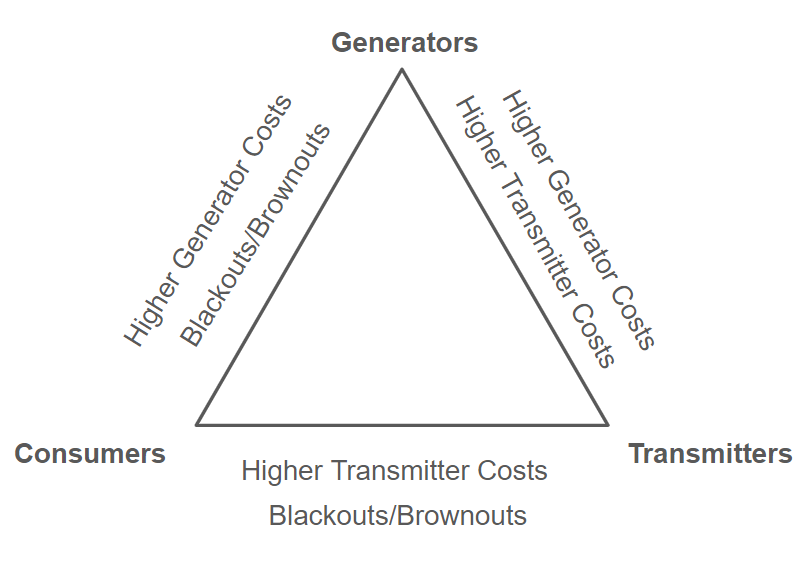
Which side of the triangle we choose depends on what we’re optimizing for. In my fairly strong-held opinion, a successful grid is a reliable one, and a combination of inefficient generators and transmitters (the right side of the triangle) gets us there. By ensuring that consumer demand can’t exceed grid capacity and trigger any emergency shutdowns, we minimize the risk of blackouts. The increased marginal costs we elected for need to be borne somewhere in the system, but at least we don’t have to worry about the thing falling apart altogether.
And conveniently for my narrative, this mirrors the real life grid operation fairly well. Generators rarely run at 100% utilization, and utilities generally install transmission lines capable of carrying the full capacity of their upstream generators. The cost of these inefficiencies are passed on by the utilities (who usually own both the generation and transmission infrastructure) to consumers, who (knowingly or otherwise) pay for both the cost of producing electricity plus the current premium for reliability.3
A bit of life
Now for the fun part - taking a boring mechanical analogy and giving it something dynamic. We’ve established a model that describes the current power grid and can predict a few of the immediate consequences that might stem from one of the three camps growing imbalanced relative to the others, but beyond that it’s static. The real grid, on the other hand, has desires. Or rather the utilities who manage the grid do, and they would very much like to maintain their stable state of reliable operation4. If we poke the beast, it fights back.
To match this, we can add a little agency to the model and argue that the system will tend to return to it’s preferred equilibrium, with generators and transmitters having greater capacity than consumers. It accomplishes this via immune responses to the stress of increasing demand, and like a living organism this stress can induce growth if balanced properly, or trigger globally counter-productive self-defenses otherwise.
In a well-tuned grid, increases in demand are matched by proportional increases in generation and transmission capacity. Steadily applied demand results in steady growth of the overall grid and all the external parties it supports, much like how consistent weight lifting protocols lead to consistent gains in the gym. Add too much stress from demand too quickly, however, and the grid will to burn out like an overeager bodybuilder.
Once increases in consumer demand outpace the grids ability to increase capacity, we start to see signs of fatigue. The system begins to respond by limiting the number of consumers who can connect to the existing grid infrastructure to protect itself, and this usually manifests itself symptomatically as increasingly long interconnection queues5. To be clear, there isn’t anything inherently wrong with this. The regulations that make up the queue behave like immune cells and prevent unchecked growth, and the presence of a queue could just indicate a healthy response to spikes in demand. If the system remains symptomatic for extended periods, however, it may indicate that regulations are overactive and the grid has developed an auto-immune disorder. Contact your local representative regarding any interconnection lasting longer than 3 years.
Jokes aside, there are other stresses that can be imposed on the system. Short term losses in generation and transmission due to storm damage etc. are generally smaller in scale and can be covered by the excess capacity already present in the grid6. Longer term ones including the planned decommissioning of coal or nuclear power plants can also lower generating capacity below already-connected consumer demand if unaddressed, and will trigger an immune response in the form of replacement generating stations to avoid blackouts. Grid managers, recall, are optimizing for reliability, and when pushed will replace decommissioned capacity with technology of similar reliability in the time frame allotted to them at the lowest cost feasible. In the real world, this looks like the state of New York decommissioning a large nuclear plant to save the climate? and all that generation capacity being replaced with natural gas turbines7.
Looking forward
There are many more dynamics to explore as we continue building out and reshaping our power grid, and a simple model of legacy infrastructure surely won’t hold everywhere. But to bring this full circle, lets talk about what it can tell us about our current decarbonization efforts.
First and foremost, the grid cannot sustain massive demand growth with an overactive immune system - permitting reform for new generation and transmission infrastructure is a must to keep up with the growing number of electric engines, datacenters, and renewable energy assets that are waiting to be built and start making a difference for the climate. We certainly don’t want to eliminate regulation entirely - no immune system is as bad as an overzealous one - but much of the effort going into deploying zero carbon assets will be wasted if we can’t find a way to get them plugged in.
We also see that decarbonization efforts which target a single camp on the grid are prone to backfire without consideration of the other two fronts. For the rollback of fossil-burning equipment to effectively eliminate emissions, plans for decommissioning needs to include installing low-carbon replacements-in-kind to avoid demand outgrowing supply. Plans for rolling out large, new low-carbon generating assets should by default include plans for installing adequate transmission capacity. And plans for removing existing low-carbon generating assets like nuclear plants should die in the cradle.
A future with abundant, sustainable energy is within our reach, but we need to be taking a more holistic approach towards it, especially with efforts like decarbonization. Strategies for accomplishing this will vary8 and we could (maybe should?) spend time writing a playbook based on technical models like the one here. But ultimately it’ll boil down to stepping beyond the models and realizing that the game is not about three competing camps or however you choose to frame it, but one coordinating whole. Real progress starts with those of us who care to influence change taking responsibility for all aspects of the systems we’re tinkering with.
The ones where you lose AC, not your wallet.
Strongly recommend researching the theory to get a more nuanced picture. Tiago Forte has a solid introduction here
As a consumer, this is obviously suboptimal. Thankfully there are groups like the Princeton Zero Lab thinking about how to bring the consumer price of electricity closer to actual cost, among other things. Very interested in following this through the future
and profits, but again, for another essay.
a similar effect can be seen when proposed increases in renewable generation capacity outpace our abilities to scale transmission. A large % of the projects waiting in queues are low-carbon, renewable energy.
If they’re large enough, you get storm induced blackouts which nobody likes but we generally chalk up to intractable acts of god and move on with repairs. whether we actually have any agency in preventing these is subject for further debate
Why natural gas? Because it can easily be ramped up and down to match demand, has a long history of working in a variety of weather conditions, the fuel is cheap, and they can be constructed relatively quickly based on decades of prior usage. This isn’t to say that this is a good thing, just that its how things currently are. Solar + batteries and renewables are not (yet) proven to be equally reliable in e.g. New England in the winter, though I’m optimistic that this is rapidly changing.
For the record, centralized planning of any sort is not the solution, we can be better. DAO protocols are my preferred path forward to solving coordination at scale while avoiding problems with central authority, though I’m woefully underread on them. Alternatively, distributed energy resources could reduce scale enough to ease coordination. I suspect there will be some very interesting emergent properties if we opt for a network of micro-networks.