I actually enjoy reading a lot of those “25 things I wish I knew before 25” essays, and while I know lots of things1, one of those things is that most of the others are probably wrong. and so sitting here, reflecting on a quarter century of hurtling through the solar system, rather than another listicle I’m writing about one thing—the thing—that I most believe was worth learning along the way.
unfortunately that thing is, again, a kind of nonsense. pure semantics. I want to talk about definitions. we inherit our initial ones through our upbringing, our schooling. what it means to be successful, to love, to suffer. the thing I want to get across to you about them is that you are not beholden to these initial definitions; you can shape and mold your own to best suit your life.
In my case, the literal life saving one was happiness. for a long while I had a fuzzy sort of background dissonance that grew and calcified into apathy early in college. I spent the better part of my education checking boxes that I was told would lead to success, to happiness, and even though I turned out fairly good at it (the checking boxes) I was miserable. it took a long time before I thought to ask "who picked these boxes anyways?" and eventually dug my way out of what had turned into a deep depression.
doing so required realizing a) my inherited definition of happiness was not congruent with the way I wanted to live my life at the time and b) I could totally rewrite that shit. which sounds trivial, trite even. but I've become increasingly convinced that this sort of dissonance between who we are and how we've been told to be applies to so many people/problems. given the spread of human personality, the definitions handed to us early in life via cultural norms are bound to be imperfect for just about everyone.
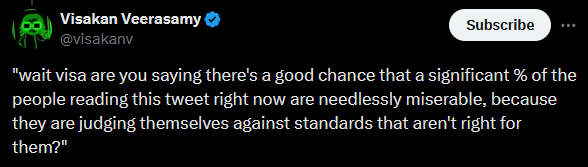
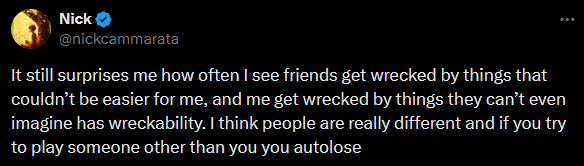
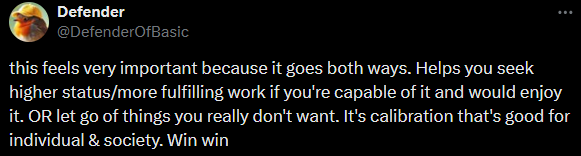
and as someone else pointed out recently, its useful for more than avoiding misery. you can play it both ways, as a letting go or a taking on.
So my latest admonition (to myself as much as anyone else) is to notice the dissonance early and realize there is something to be done about that. ask if that’s really the game you want to be playing, and if not, author your own. you gotta dream your own dream rather than numbing out. the yardsticks of life are opensource baby. choose to be happy2
conversations I’m having/things I’m reading
the above bit is part of a larger point that I’m still dancing around often. so many of the fixtures we take for granted in life (systems of governance, ethics, religion etc.) are products of narratives that are up for reauthoring as much as you own personal stance on success. what does it look like to dedicate a life to building a better city, or bringing water back to the West, or reimagining faith without the broken scaffolding of the Church? How far can we take it, and how few of us are needed to pull it off?
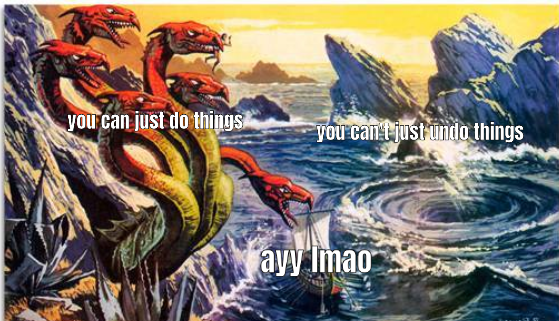
presented without further comment:
talking with a friend about why we climb/ski etc. in ways that occasionally risk life and limb, or at all. seems that for a lot of us injecting a meaningful risk of failure is one of the few ways we manage to stay sane in a world where safety and conventional success are all but guaranteed. I’d like to somehow draw a line between caring and meaning but don’t have the full thought yet3
Bill Finnegan’s Barbarian Days captures some of the magic found in those fleeting moments riding the face of a wave as it crashes over you, that same magic of steep chutes and deep powder, and the bittersweetness of pursuing that at all costs. his love of Kerouac and the impending ski season have me itching. I can’t recommend it enough, and suggest pairing with Hansman’s Powder Days to crank up the longing
Finished reading Virgil Wander at the recommendation of a friend and loved every damn page. I know what I’m buying everyone for Christmas now
I’ve been getting more and more excited about the potential for solar + batteries to reshape our energy landscape and don’t think people are updating on the topic fast enough. Austin Vernon’s paper on Energy Superabundance and solar policy changes are part of this inspiration. Also seeing the quiet adoption of solar across much of oil & gas - the economics seem to have finally shifted.
no, I will not be taking questions on this statement at this time
this phrasing tends to make a few of my friends mad. the meta-point here is that you can choose frames that suit you; if this one of mine is bothersome, choose your own :)
I’m drawn to thinking that this question is better approached side-on. most of my favorite writing on the subject is closer to poetry than philosophy